I strongly believe we must lead AI, not let it lead us. What does that really mean? In this article, I’ll show you how I led AI from my 100% original work to what you are reading now.
To lead AI, we must be fully present and human. It requires us to know ourselves, our thinking, values, and discernment, rather than just becoming expert prompters. Easy to say, harder to do. As Shakespeare said, “This above all: to thine own self be true.”
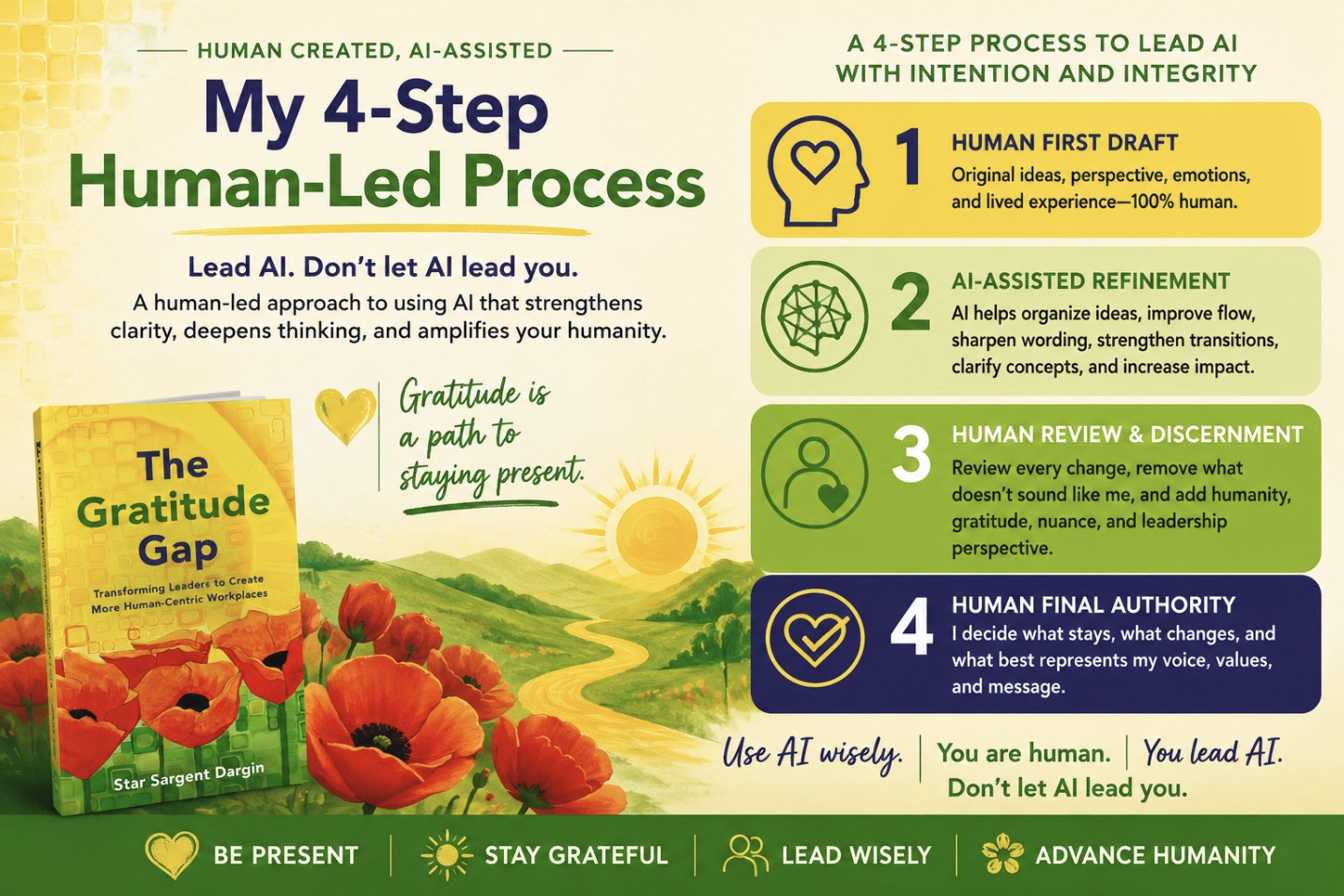
This post is an example output of a human-created, human-led, AI-assisted process that I use for reports and short articles. Me being the human, and a paid version of Chat-GPT.
Here are the steps I took; you can see the examples below.
Step 1: Human first draft. 118 words
I wrote the original messy draft myself. The ideas, perspective, emotions, leadership philosophy, lived experience, and new thinking came from 100% me, not AI. I use Grammarly for grammar corrections.
Step 2: AI-assisted refinement. 238 words.
I used AI to help:
- organize ideas
- improve flow
- sharpen wording
- strengthen transitions
- clarify concepts
- increase readability and influence
This step adds a lot of words, which is important to me because I tend to jump too quickly and not provide transitions between ideas.
Step 3: Human review and discernment. 241 words.
I cut and pasted AI into Word, then edited and reviewed every change. I removed wording that did not sound like me. I added humanity, gratitude, nuance, and leadership perspective.
Step 4: Human final authority. 265 words.
I edited it directly in the app. I decided what stayed, what changed, what aligned with my values, and what best represented my voice and message. You can read the final human-led with AI collaboration below. This is what you are reading now, Step 4.
Why is this important?
Because AI is not just about accelerating work. It can help accelerate clarity, deepen thinking, improve quality, expose blind spots, strengthen communication, and spread new ideas faster.
Yet the danger is when people stop thinking for themselves and begin outsourcing discernment, quality, creativity, identity, and meaning to AI.
Gratitude matters because it is a path to staying present. Staying present in leading AI, not just blindly following.
Without presence, it becomes easy to unconsciously hand leadership and thinking over to technology.
The goal is to advance humanity in a positive, quality, and loving way while wisely using powerful tools, like AI. Yes, AI is a tool that can cut or build.
Step 4 – Human Final Authority. Example Output of Human-Created, AI-Collaborated.
Use AI wisely. You are human. You lead AI. Don’t let AI lead you.
What does that really mean? Let me give you an example.
Leading is different for everyone. Every leader is unique.
You may be a:
- Creator, inventor, or opportunity seeker.
- Big-picture thinker or someone who loves building from the ground up.
- Thrive on constant interaction with people or need long stretches of solitude.
- Overthink, over-perfect, over-research… or completely wing it.
- Process out loud. Others need silence first.
All of that came from little ole human me. Not AI.
AI can help organize ideas, sharpen wording, summarize, brainstorm, and accelerate learning. I use it almost every day. Yet the direction, humanity, lived experience, discernment, creativity, values, and voice must come from you.
That’s the difference between leading AI and being led by it.
Right now, I see many people chasing AI so fast that they are disconnecting from themselves. We risk becoming curators of AI output rather than original thinkers. Our voices start to sound like everyone else’s. Thinking becomes generic. Humanity gets flattened.
Don’t lose yourself.
Use AI wisely. Let it support, not replace, your thinking.
Let it amplify your humanity, not dilute it.
Let it help you create, not tell you who you are.
The future does not belong to the people who can prompt AI the fastest.
It belongs to the people who still know how to think, feel, discern, connect, create, and lead as humans. The people who are present. Gratitude is a path to being present.
Don’t just learn AI. Stay grateful and keep learning yourself. I am!
Step 3 – Human Review and Discernment, Here’s my edit from AI’s first pass
Use AI wisely. You are human. You lead AI. Don’t let AI lead you.
What does that really mean? Let me give you an example.
Leading is different for everyone. Every leader is unique.
You may be a creator, inventor, or opportunity seeker.
You may be a big-picture thinker or someone who loves building from the ground up.
You may thrive on constant interaction with people or need long stretches of solitude to think clearly.
You may overthink, over-perfect, over-research… or completely wing it.
All of that came from me. Little ole human me. Not AI.
AI can help organize ideas, sharpen wording, summarize, brainstorm, and accelerate learning. I use it almost every day. Yet the direction, humanity, lived experience, discernment, creativity, values, and voice must come from you.
That’s the difference between leading AI and being led by it.
Right now, I see many people chasing AI so fast that they are slowly disconnecting from themselves. Their voice starts to sound like everyone else’s. Their thinking becomes generic. Their humanity gets flattened.
I don’t recommend losing yourself.
Use AI wisely. Let it support your thinking, not replace it.
Let it amplify your humanity, not dilute it.
Let it help you create, not tell you who you are.
The future does not belong to the people who can prompt AI the fastest.
It belongs to the people who still know how to think, feel, discern, connect, create, and lead as humans.
Step 2 – AI Assist and Refinement, AI’s first pass from my draft
Use AI wisely. You are human. You lead AI. Don’t let AI lead you.
What does that actually mean? Let me give you a simple example.
Leading looks different for everyone.
You may be a creator, inventor, or opportunity seeker.
You may be a big-picture thinker or someone who loves building from the ground up.
You may thrive on constant interaction with people or need long stretches of solitude to think clearly.
You may overthink, over-perfect, over-research… or completely wing it.
All of that came from me. Little ole human me.
Not AI.
AI can help organize ideas, sharpen wording, summarize, brainstorm, and accelerate learning. I use it almost every day. Yet the direction, humanity, lived experience, discernment, creativity, values, and voice still have to come from you.
That’s the difference between leading AI and being led by it.
Right now, I see many people chasing AI so fast that they are slowly disconnecting from themselves. Their voice starts sounding like everyone else’s voice. Their thinking becomes generic. Their humanity gets flattened.
Don’t do that.
Use AI wisely. Let it support your thinking, not replace it.
Let it amplify your humanity, not dilute it.
Let it help you create, not tell you who you are.
The future does not belong to the people who can prompt AI the fastest.
It belongs to the people who still know how to think, feel, discern, connect, create, and lead as humans.
Step 1 – Human First Draft (no AI), the first messy draft.
Use AI wisely, you be human. You lead AI, don’t let it lead you.
What does that really mean, and can I show you an example?
Leading is different for everyone.
You may be a creator, inventor, or opportunity seeker.
You may be a big picture or build from the group up person.
You may thrive on interacting with people or need more solitude.
You may overthink, over-perfect, or just wing it. All of these words in Step 1, I wrote, little ole me.
Here’s the process and steps I use to create an article in collaboration with AI:
- Human first
- AI version
- Human edits AI version
- Human asks for suggestions and incorporates, cycle this till done. Human Final Authority.
What do you notice when you are present with AI? Is it hard or easy to lead AI?
Check out my book, The Gratitude Gap. It’s a way to make visible the invisible, unique challenges of gratitude, so that you can grow your gratitude and BE PRESENT, to LEAD AI.
P.S. This is not how I wrote The Gratitude Gap. For the book, I wrote the manuscript myself, worked with three human editors over four years, through multiple revisions, and when the manuscript was nearly complete, I used AI as a consultant. I believe new ideas and structures deserves deep human reflection. This human-led AI process is one I currently use for reports, articles, and other shorter pieces where clarity and iteration are especially valuable.